
Every missing-person case is a human life at stake — a family searching, a community worried, a clock that won’t slow down. But beyond the headlines, the statistics paint a revealing picture of how often people go missing, how few cases are formally resolved, and why reactive safety tools aren’t enough.
The Big Picture: How Many People Go Missing Each Year?
According to data from the FBI’s National Crime Information Center (NCIC) and national missing-persons systems:
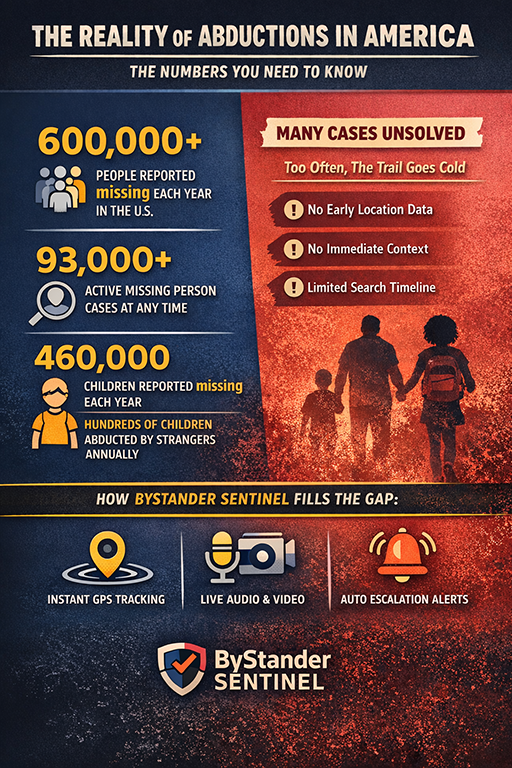
- An estimated 600,000+ people are reported missing annually in the United States, with nearly 1,600 reports filed every day. (LOVERS ROCK)
- Of these reports, tens of thousands remain unresolved at any given time, even as many are eventually located or return. (World Population Review)
- As of the end of 2024, there were over 93,000 active missing-person records in official databases. (Federal Bureau of Investigation)
That’s a nationwide situation — and not every active case is a criminal abduction, but every unresolved case is a family without answers and a community seeking closure.
How Many Cases Are Actually Resolved?
One of the persistent challenges in missing-person data is the distinction between reports and resolution:
- Many people reported missing are located or return within a short time, often within days. (LEB)
- However, thousands — ranging in the tens of thousands each year — remain unresolved long after reporting, often without clear explanations. (World Population Review)
Resolution rates vary dramatically based on age, circumstances, and whether law enforcement considers a case high-priority. But the raw truth is this: not every missing person is found quickly, and not every abduction is solved with the information available today.
Child Abductions: Rarity and Reality
Nationally:
- An estimated 460,000 children are reported missing each year — though not all are violent abductions; many involve runaways or family disputes. (NCP Task Force)
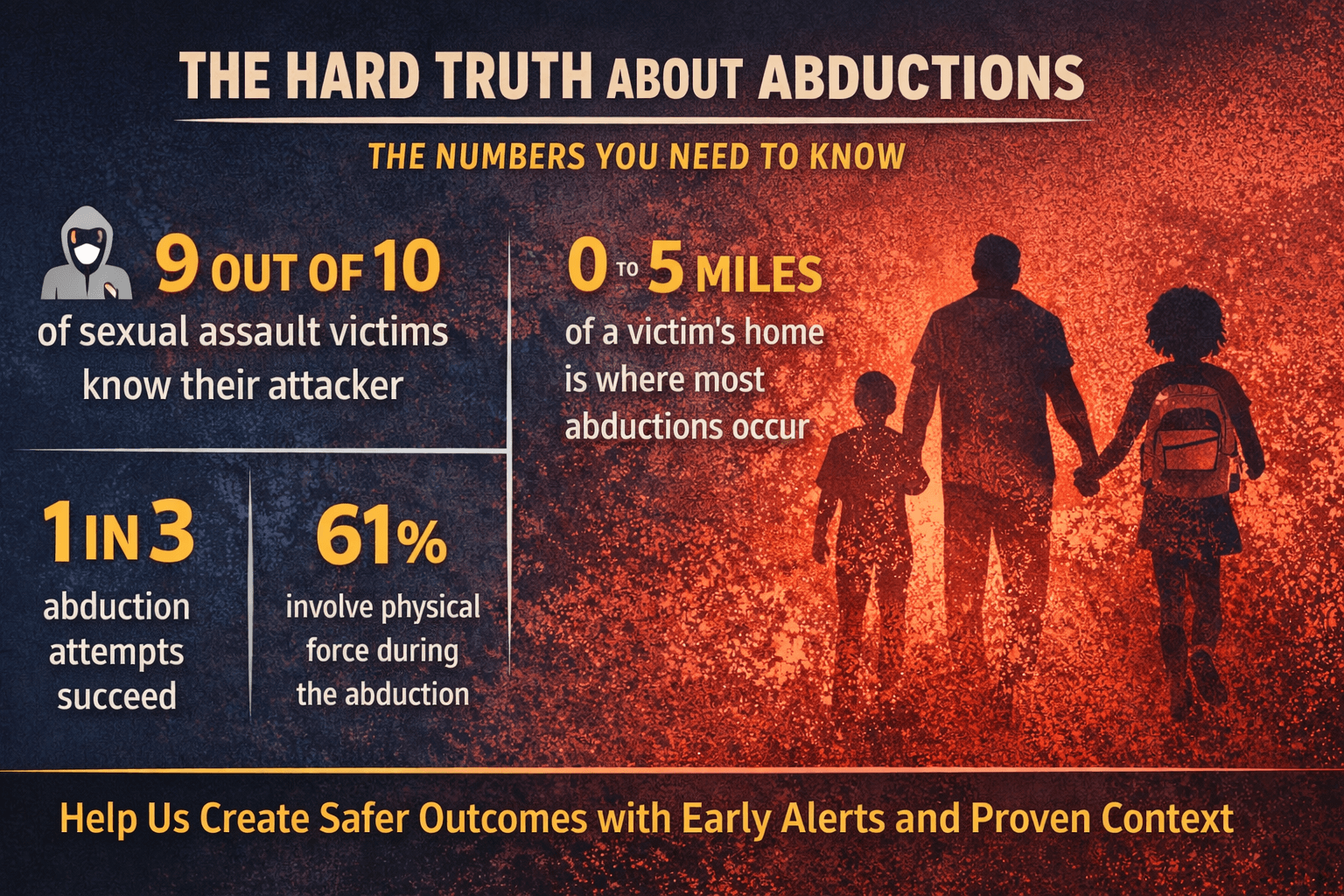
- Traditional stranger abduction cases — where a child is taken by someone unknown and held — are relatively rare, numbering in the hundreds annually rather than tens of thousands. (Times Union)
- Even so, every missing child — runaway or not — is at increased risk of exploitation, trafficking, or harm when unlocated. (NCP Task Force)
This means the perceived danger of abduction captures public attention, but the real danger is being unaccounted for while vulnerable — and law enforcement often doesn’t have the early context or data needed to intervene effectively.
Why Traditional Tools Aren’t Enough
Most safety systems assume:
✔ The person can call 911
✔ The person can verbalize location and threat
✔ The dangers will be obvious
But terror, confusion, and coerced silence don’t wait for clarity.
That’s the gap ByStander Sentinel was built to fill.
What ByStander Brings to the Numbers
When someone is in a situation that feels wrong, reactive systems wait for a detailed report — which might never come. Sentinel instead:
Captures Critical Data in the Moment
With a single activation, Sentinel begins recording:
- Live GPS tracking
- Optional audio/video
- Direction of movement
This turns uncertainty into evidence — early and actionable evidence.
Preserves Time-Stamped Location and Context
Traditional missing-person investigations often begin after a disappearance is reported. Sentinel can mark the moment danger began, giving law enforcement a real head start.
Escalates Automatically if the User Can’t Speak
If a person is unable to call or communicate, Sentinel doesn’t stop at hesitation — it escalates alerts to contacts and safety support when a preset window expires.
What Early Intervention Can Change
Without early context:
➡ Missing-person cases can become cold files
➡ Location data is based on last known contact
➡ Investigations rely on chance sightings and tips
With real-time data from Sentinel:
✔ Location is precise
✔ Audio/video can corroborate events
✔ Response teams have a starting timeline
This is not speculation — rapid context dramatically improves search efficiency in critical early hours.
Final Numbers You Can’t Ignore
- ~600,000 missing-person reports annually in the U.S. — and still rising. (LOVERS ROCK)
- Tens of thousands unresolved at any time, meaning families wait for answers with limited data. (World Population Review)
- Hundreds of child abductions by strangers each year, but many more children unaccounted for temporarily — all at risk. (Times Union)
These numbers remind us that waiting for resolution isn’t a strategy — it’s a gap.
ByStander Sentinel is not just a safety tool — it’s a response system designed to put information where it matters most: right when danger begins.