
Author: 879537pwpadmin

  • ByStander Enters Final Development & Quality Assurance Phase

    ByStander Enters Final Development & Quality Assurance Phase

    We’re excited to share that ByStander is now in the final stages of development.

    The core features of the app are built, workflows are in place, and we are currently focused on bug fixing, performance optimization, and quality assurance (QA) testing across devices and scenarios.

    This phase is intentional—and critical.


    Why We’re Taking Extra Time

    ByStander is not a casual app. It’s designed for moments that matter—situations involving personal safety, awareness, and real-time decision-making. Because of that, our priority is not speed to market, but reliability at launch.

    We are rigorously testing:

    • Workflow activation and cancellation
    • Live streaming stability
    • Location accuracy
    • Notification delivery
    • Advocate connectivity
    • Evidence capture and storage
    • Edge cases where users may be unable to act quickly

    Our goal is simple: launch with confidence, not patches.


    Quality Assurance Comes First

    During QA testing, we simulate real-world conditions to ensure the app performs as expected when it’s needed most. This includes:

    • Different device types and operating systems
    • Low-signal and poor connectivity environments
    • Extended usage scenarios
    • Fail-safe and recovery behavior

    We’re addressing issues now—before launch—because reliability is not optional when safety is involved.


    A Responsible Launch Philosophy

    Many apps rush to market and fix issues later. For a service like ByStander, that approach isn’t acceptable.

    We believe a responsible launch means:

    • Fewer bugs
    • Clearer user experience
    • Stronger trust from day one
    • Less friction in critical moments

    Taking the time now helps ensure the app works when users need it—not after an update.


    What’s Next

    As QA testing concludes, we’ll move into:

    • Final performance tuning
    • App Store and Google Play submission
    • Advocate onboarding
    • Launch preparation and rollout

    We’re grateful for the patience and support from our early community, backers, and partners as we take these final steps.

    ByStander is being built with care—because the moments it’s designed for deserve nothing less.


  • If Time Had Spoken Louder: It Didn’t Have To Be Like This

    If Time Had Spoken Louder: It Didn’t Have To Be Like This

    How ByStander Sentinel Could Have Changed the Outcome in the Nancy Guthrie Case—and How It Will Help Prevent Future Abduction


    As the search continues in 2026 for Nancy Guthrie, communities are once again confronted with a painful question we ask far too often: What if help had arrived sooner?

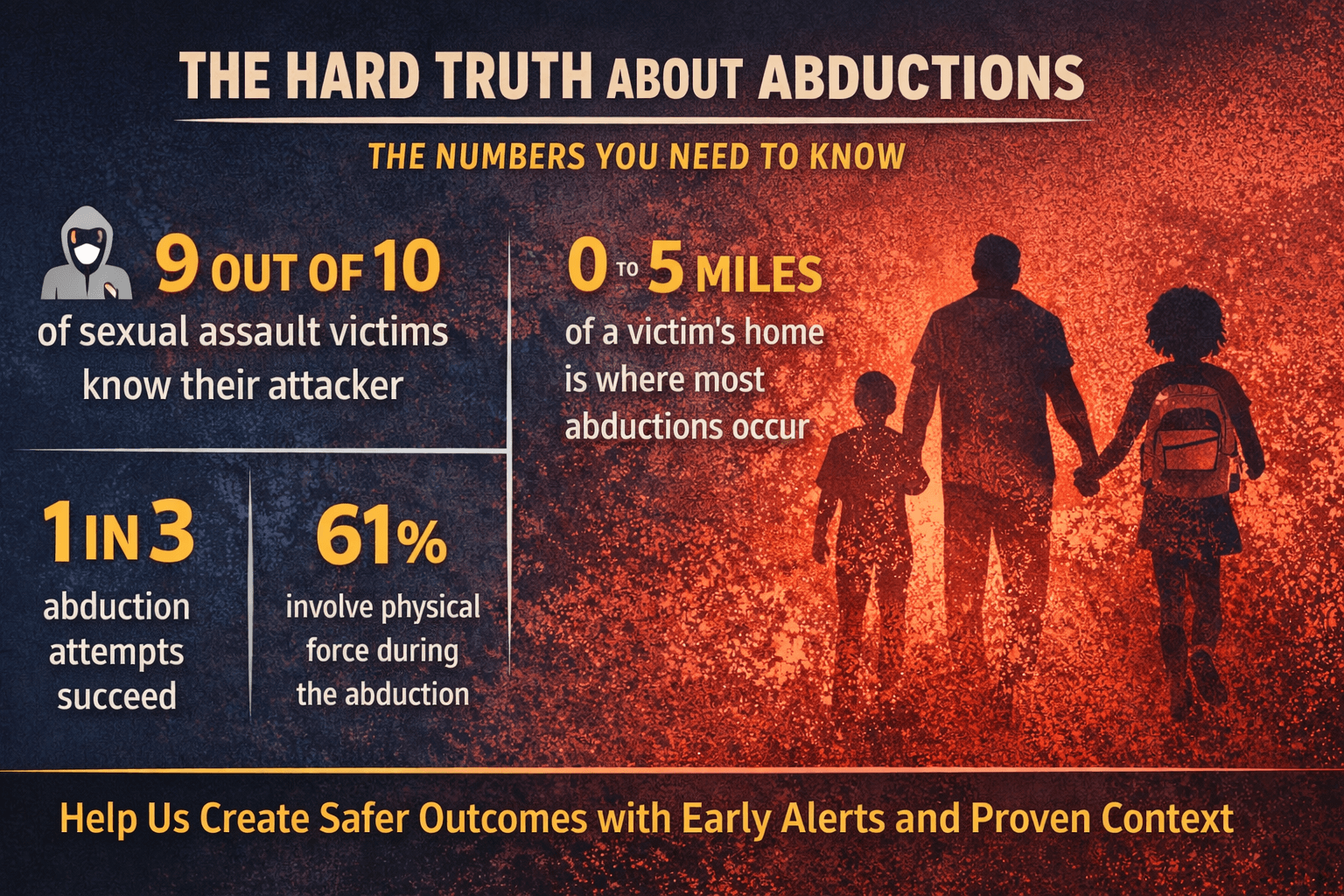
    When a person goes missing, the window for intervention is brutally small. Minutes matter. Context matters. And most importantly, silence is often the enemy. Many abductions and disappearances do not begin with violence—they begin with unease, confusion, coercion, or a moment when someone knows something isn’t right but doesn’t yet feel justified calling 911.

    This is the gap ByStander Sentinel was designed to close.

    The Silent Minutes Before Everything Changes

    In many real-world cases, individuals experience warning signs before they vanish:

    • Being followed
    • Feeling watched
    • A forced “help” interaction
    • A sudden deviation from routine
    • Fear without clear proof of danger

    In these moments, people often hesitate. They don’t want to overreact. They don’t want to cause alarm. And tragically, those moments are often the last chance to leave a digital trail.

    ByStander Sentinel exists for that exact hesitation.

    How ByStander Sentinel Could Have Made a Difference

    Had a system like ByStander Sentinel been active during the moments leading up to Nancy Guthrie’s disappearance, several critical safeguards could have been triggered before she went missing:

    1. One-Action Activation in a Moment of Fear
    Sentinel is designed so that a user does not need to explain, dial, or justify. A single press initiates protection. No conversation. No delay.

    2. Automatic GPS Location Capture
    The moment Sentinel is activated, live location data is secured and shared with designated emergency contacts. Even if the device is later disabled, the last known coordinates are preserved.

    3. Live Audio/Video Context (When Available)
    Instead of investigators asking “What might have happened?”, Sentinel can provide real-time situational context—sounds, movement, voices, direction of travel.

    4. Escalation Without User Intervention
    If the user cannot cancel the alert with a PIN within a short safety window, Sentinel escalates automatically—alerting trusted contacts and, where enabled, trained safety advocates who can relay verified data to authorities.

    5. A Timeline, Not Just a Name
    Too many missing-person cases begin with a photo and a hope. Sentinel creates a timeline, which dramatically improves search accuracy and response coordination.

    What Makes Sentinel Different From Traditional Safety Tools

    Most personal safety tools are reactive. Sentinel is preventive and anticipatory.

    • It assumes the user may lose the ability to speak
    • It assumes fear may precede certainty
    • It assumes help should move toward the user, not wait for a call

    Sentinel does not ask, “Are you sure this is an emergency?”
    It asks, “What if it is?”

    Combatting Abductions Before They Become Disappearances

    The long-term goal of ByStander Sentinel is not just response—it’s deterrence and disruption.

    When potential abductors know:

    • Location is being tracked
    • Evidence may already be captured
    • Third parties are alerted instantly

    …the calculus changes.

    Sentinel shifts power back to the individual in the most vulnerable moment—before isolation, before silence, before disappearance.

    A Call for Prevention, Not Just Posters

    As communities rally around Nancy Guthrie and others like her, we must confront a hard truth: awareness after the fact is not enough.

    Posters help find people.
    Technology helps keep them from going missing in the first place.

    ByStander Sentinel was built for the moment when someone feels unsafe but doesn’t yet know how to prove it. For the moment when fear whispers before danger shouts.

    If that moment is ever met with action instead of silence, fewer names will be added to search lists—and more people will make it home.


  • When Numbers Tell the Story: Why ByStander Is Needed Now More Than Ever

    When Numbers Tell the Story: Why ByStander Is Needed Now More Than Ever


    Every missing-person case is a human life at stake — a family searching, a community worried, a clock that won’t slow down. But beyond the headlines, the statistics paint a revealing picture of how often people go missing, how few cases are formally resolved, and why reactive safety tools aren’t enough.

    The Big Picture: How Many People Go Missing Each Year?

    According to data from the FBI’s National Crime Information Center (NCIC) and national missing-persons systems:

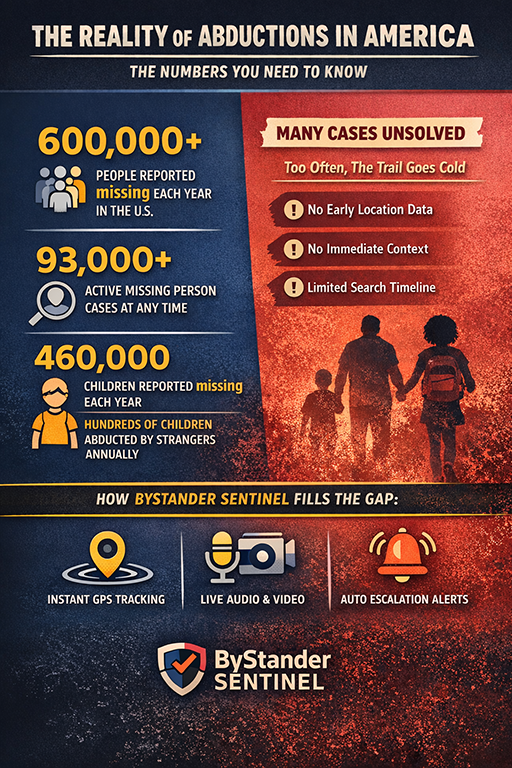
    • An estimated 600,000+ people are reported missing annually in the United States, with nearly 1,600 reports filed every day. (LOVERS ROCK)
    • Of these reports, tens of thousands remain unresolved at any given time, even as many are eventually located or return. (World Population Review)
    • As of the end of 2024, there were over 93,000 active missing-person records in official databases. (Federal Bureau of Investigation)

    That’s a nationwide situation — and not every active case is a criminal abduction, but every unresolved case is a family without answers and a community seeking closure.

    How Many Cases Are Actually Resolved?

    One of the persistent challenges in missing-person data is the distinction between reports and resolution:

    • Many people reported missing are located or return within a short time, often within days. (LEB)
    • However, thousands — ranging in the tens of thousands each year — remain unresolved long after reporting, often without clear explanations. (World Population Review)

    Resolution rates vary dramatically based on age, circumstances, and whether law enforcement considers a case high-priority. But the raw truth is this: not every missing person is found quickly, and not every abduction is solved with the information available today.

    Child Abductions: Rarity and Reality

    Nationally:

    • An estimated 460,000 children are reported missing each year — though not all are violent abductions; many involve runaways or family disputes. (NCP Task Force)
    • Traditional stranger abduction cases — where a child is taken by someone unknown and held — are relatively rare, numbering in the hundreds annually rather than tens of thousands. (Times Union)
    • Even so, every missing child — runaway or not — is at increased risk of exploitation, trafficking, or harm when unlocated. (NCP Task Force)

    This means the perceived danger of abduction captures public attention, but the real danger is being unaccounted for while vulnerable — and law enforcement often doesn’t have the early context or data needed to intervene effectively.


    Why Traditional Tools Aren’t Enough

    Most safety systems assume:
    ✔ The person can call 911
    ✔ The person can verbalize location and threat
    ✔ The dangers will be obvious

    But terror, confusion, and coerced silence don’t wait for clarity.

    That’s the gap ByStander Sentinel was built to fill.


    What ByStander Brings to the Numbers

    When someone is in a situation that feels wrong, reactive systems wait for a detailed report — which might never come. Sentinel instead:

    Captures Critical Data in the Moment

    With a single activation, Sentinel begins recording:

    • Live GPS tracking
    • Optional audio/video
    • Direction of movement

    This turns uncertainty into evidence — early and actionable evidence.

    Preserves Time-Stamped Location and Context

    Traditional missing-person investigations often begin after a disappearance is reported. Sentinel can mark the moment danger began, giving law enforcement a real head start.

    Escalates Automatically if the User Can’t Speak

    If a person is unable to call or communicate, Sentinel doesn’t stop at hesitation — it escalates alerts to contacts and safety support when a preset window expires.


    What Early Intervention Can Change

    Without early context:
    ➡ Missing-person cases can become cold files
    ➡ Location data is based on last known contact
    ➡ Investigations rely on chance sightings and tips

    With real-time data from Sentinel:
    ✔ Location is precise
    ✔ Audio/video can corroborate events
    ✔ Response teams have a starting timeline

    This is not speculation — rapid context dramatically improves search efficiency in critical early hours.


    Final Numbers You Can’t Ignore

    • ~600,000 missing-person reports annually in the U.S. — and still rising. (LOVERS ROCK)
    • Tens of thousands unresolved at any time, meaning families wait for answers with limited data. (World Population Review)
    • Hundreds of child abductions by strangers each year, but many more children unaccounted for temporarily — all at risk. (Times Union)

    These numbers remind us that waiting for resolution isn’t a strategy — it’s a gap.

    ByStander Sentinel is not just a safety tool — it’s a response system designed to put information where it matters most: right when danger begins.