01
“I’m safe.”
Everyday life continues without intervention. Privacy and normalcy remain the default.
SafeBridge fills the space between “I’m safe” and 911—giving residents support, responsible professionals clearer context, and Chicago a better way to build trust before a situation becomes an emergency.
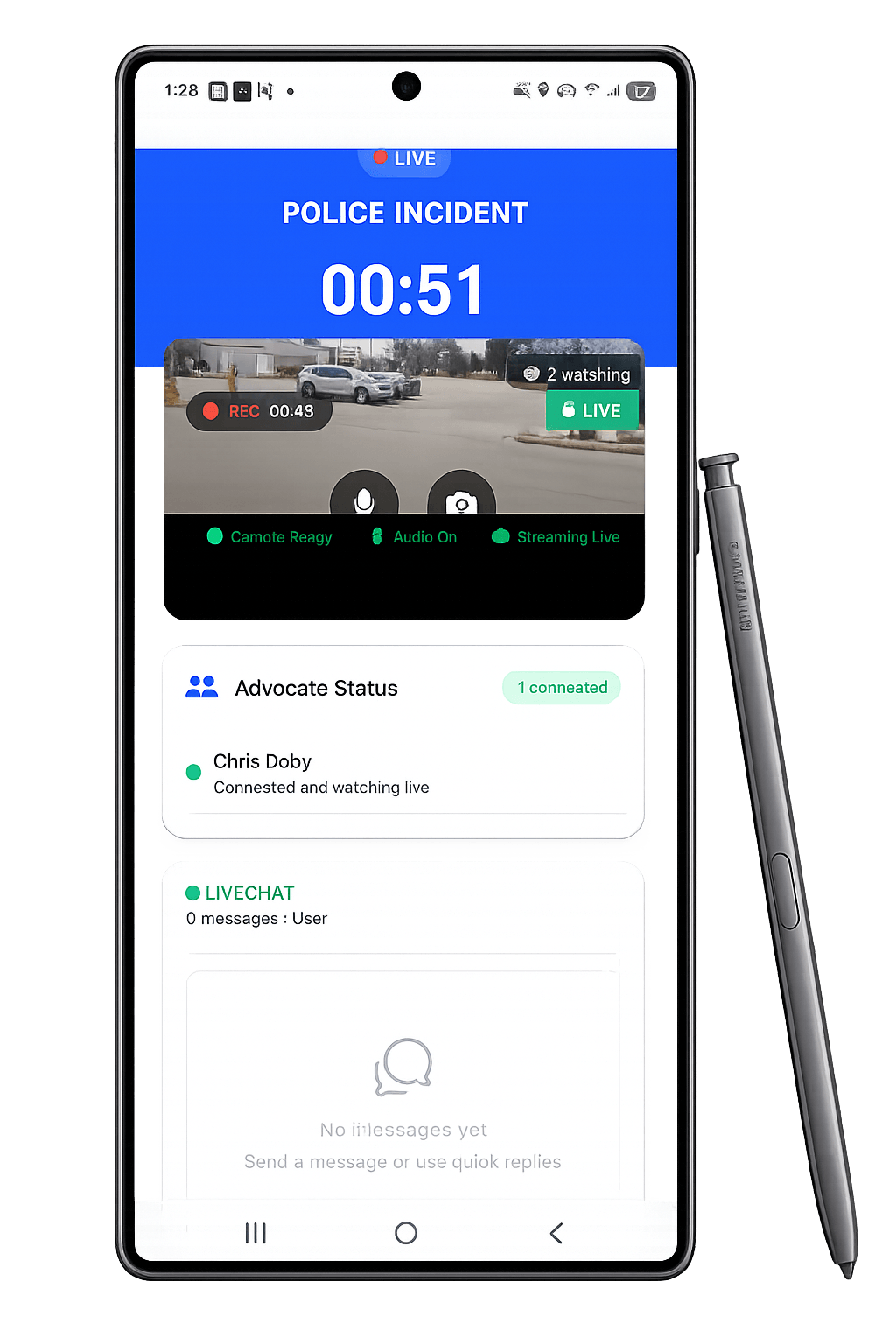
A traffic stop feels tense. A late-night walk turns uncertain. A family member misses a check-in. A resident wants someone to see what is happening before choosing whether to escalate. Today, that space is often empty. SafeBridge is designed to fill it.
Everyday life continues without intervention. Privacy and normalcy remain the default.
The person wants awareness, connection, or a credible witness—but the situation may not yet be an emergency.
Location, live context, trusted contacts, and trained community support create visibility and a path forward.
When the threshold is met, the person or advocate can escalate to 911 with clearer situational context.
SafeBridge is not anti-police and it is not a substitute for professional public safety. It is a visibility layer designed to help residents feel seen and help professionals who do their jobs correctly maintain the confidence of the communities they serve.
When conduct is responsible, a credible record helps protect that work. When misconduct occurs, visibility makes it harder to hide behind confusion or conflicting accounts.
Independent context can clarify what happened, reduce speculation, support fair review, and reinforce public confidence in responsible service.
Documented patterns can make repeated misconduct more visible, support accountable investigation, and help leadership identify where policy or training must change.
SafeBridge connects people, trained advocates, trusted contacts, and professional emergency response through one locally governed operating model.

A fast way to activate live location, stream context, notify trusted contacts, and bring another responsible person into the moment.
Background-checked community members trained in boundaries, de-escalation, documentation, bias awareness, and emergency escalation.
Time-stamped records governed by clear retention, access, privacy, and due-process policies established before the pilot begins.
A public scorecard focused on connection, appropriate escalation, privacy compliance, resident confidence, and operational improvement.
The goal is not to turn every concern into a police call. The goal is to give Chicagoans a responsible option before fear, isolation, or uncertainty becomes crisis.
Activate visibility, location, trusted contacts, and a clear record during an encounter that feels uncertain.
Start discreet monitoring during a walk, meetup, commute, or interaction that does not yet meet the threshold for 911.
Create a structured check-in path when a resident may need attention, support, or escalation to professional care.
Support campuses, transit corridors, public events, workplaces, and neighborhood programs with locally defined response paths.
A Chicago pilot should begin with governance, community input, frontline participation, legal review, and clear success measures—not slogans or untested citywide promises.
Define the pilot area, use cases, response boundaries, privacy rules, evidence access, oversight, and participating partners.
Recruit and vet advocates, rehearse scenarios, test technology, connect emergency pathways, and prepare public education.
Launch within a defined environment, monitor daily, publish an initial scorecard, and decide whether to revise, expand, or stop.
Pilot targets would be finalized with city, community, public-safety, privacy, and evaluation partners. The scorecard should answer practical questions.
Measure activation reliability and time to a trained human connection.
Track when advocates escalate, why, and whether the pathway worked as designed.
Understand which situations reached a safe conclusion without emergency dispatch.
Survey residents, advocates, and participating professionals before and after the pilot.
Evaluate whether documentation supported fair review while protecting due process.
Audit consent, access, retention, deletion, and any policy exceptions.
The complete SafeBridge Chicago proposal is reproduced below and available as a seven-page, SafeBridge-branded PDF.

SafeBridge Chicago is a community-powered public-safety proposal that fills the space between everyday safety and a 911 call. It gives residents a visible, trusted connection in uncertain moments, gives responsible professionals a clearer record, and gives Chicago a measurable way to rebuild trust between communities and police.
Trust and justice depend on the same thing: a fair account of what happened. Too many encounters end in conflicting stories, fear on both sides, and no credible record. SafeBridge changes that by combining the ByStander safety app, live today on iOS and Android, with trained community advocates and clear rules for privacy and due process.
We propose to start small. A 90-day pilot in one defined Chicago setting builds the rules first, trains the people second, and publishes results on a public scorecard. Chicago scales only what works.
A partner to host the pilot, a briefing with public-safety leadership, and support to recruit and train the first cohort of community advocates.
Not every concern begins as a 911 call. A traffic stop feels tense. A late-night walk turns uncertain. A family member misses a check-in. A resident wants someone to see what is happening before deciding whether to escalate. Today, that space is mostly empty.
SafeBridge is designed to fill it across four stages:
Safety does not hold where trust has broken down. Residents who do not trust police are less likely to call, come forward, or cooperate. Officers who expect hostility walk into every encounter on edge, and both sides end up less safe.
SafeBridge is not anti-police. It is a visibility layer that protects people who do their jobs right and surfaces conduct that must change.
This is how trust and justice are restored together. Not by picking a side, but by making a credible record available to everyone.
The idea started close to home. A close friend who serves as a Chicago police officer once shared a fear: that a routine stop could turn dangerous simply because someone panicked. ByStander's Traffic Stop feature was built to keep those moments calm for everyone involved.
SafeBridge connects residents, trained advocates, trusted contacts, and professional emergency response through one locally governed operating model.
In practice, an activation in the app brings in a trained advocate, who can draw on community support and coordinate a 911 response when the threshold is met.
ByStander is the platform that powers SafeBridge, and it is already live: ByStander Personal Safety on the Apple App Store and ByStander Live on Google Play. The pilot does not wait on new software.
The app includes six features: Risky Situation, Traffic Stop, Scout, Checkpoint, Location Sharing, and LifeSupport. Two carry the core of SafeBridge:
Built on a standard. The ByStander Safety Standard (BSS v1.0) is adopted and governs how evidence is captured, encrypted, stored, and accessed. Evidence is encrypted and held in secure cloud storage with controlled access.
Consent by design. Contacts are alerted only by the user's own triggers. Location is shared only when the user turns it on. There is no passive visibility, and users set their own parameters.
The goal is not to turn every concern into a police call. It is to give Chicagoans a responsible option before fear, isolation, or uncertainty becomes crisis.
The pilot launches small and measures honestly. Governance, community input, frontline participation, and legal review all come before launch in any setting.
Each phase gates the next. At Day 90, public findings decide whether SafeBridge is revised, expanded, or stopped.
No victory laps without evidence. SafeBridge reports on a public scorecard, with pilot targets finalized alongside city, community, public-safety, privacy, and evaluation partners.
| Measure | Question it answers | How it is tracked |
|---|---|---|
| Connection | Did help arrive? | Activation reliability and time to a trained human connection |
| Escalation | Was 911 used appropriately? | When advocates escalate, why, and whether the pathway worked as designed |
| Resolution | What ended safely? | Situations that reached a safe conclusion without emergency dispatch |
| Trust | Did people feel seen? | Surveys of residents, advocates, and participating professionals before and after |
| Accountability | Did records clarify events? | Whether documentation supported fair review while protecting due process |
| Privacy | Were the rules followed? | Audits of consent, access, retention, deletion, and any policy exceptions |
Every rule is set before the pilot begins, not after. SafeBridge runs under one locally governed operating model with clear limits.
All pilot features, integrations, governance rules, and public-sector relationships remain subject to legal, operational, procurement, privacy, labor, community, and agency review.
SafeBridge supports professional public safety. It never replaces it.
| SafeBridge is | SafeBridge is not |
|---|---|
| A visibility layer between everyday safety and 911 | A replacement for 911 or professional emergency response |
| A credible, time-stamped record that supports fair review | An anti-police tool |
| Support from trained, background-checked community advocates | Surveillance: nothing is shared without the user's consent |
| A small, measured pilot with public results | An untested citywide promise |
SafeBridge is built to deliver without a heavy price tag. ByStander's mobile platform was built in two months for under $200 a month, after developer quotes came in at ten months and over $1 million.
Because the platform already exists and is live, pilot dollars go to people: recruiting, vetting, and training community advocates, plus independent evaluation. The pilot budget is finalized with partners during Days 1 to 30, once the setting and scope are set.
The advocate model also builds a trained community workforce, rooted in the neighborhoods it serves.
SafeBridge is looking for partners ready to test it in one defined Chicago setting: civic leaders, agencies, universities, community organizations, employers, and funders.
Strong first settings include a neighborhood or ward, a city public-safety pilot, a university campus, a transit corridor, a business district, a community organization, or a public venue.
Start the conversation at bystander.life/safebridge-chicago.
David Jordan, Founder of SafeBridge Chicago and Founder and CEO of ByStander Inc. David brings more than 20 years of IT and AI leadership and holds the IAPP Artificial Intelligence Governance Professional (AIGP) certification. He is also a pastor and community leader who has stood with families after violent deaths, mediated in tense moments, and worked to prevent retaliation before it started. SafeBridge grew out of that work.
ByStander Inc. was incorporated in Illinois in 2020. The Village of Bolingbrook and other institutions have expressed interest in the technology, and a university has requested a campus pilot.
David Jordan
Independent proposal. SafeBridge is a community-powered public-safety concept developed by ByStander Inc. It is not affiliated with, authorized by, or endorsed by any political campaign, candidate, government agency, police department, emergency service, or the City of Chicago. SafeBridge is not 911. In an emergency, call 911.
Tell us where you see the greatest need. We will turn your answers into a focused first conversation—without making you write a proposal from scratch.
Required fields are marked with an asterisk.